Protect the exit multiple your product roadmap is quietly putting at risk.
Tech diligence audits the code. Product diligence audits the strategy. Neither checks whether the design operations behind that roadmap can keep engineering shipping at the velocity and stability your exit depends on — the gap a buyer's diligence team will find and price into their offer. We audit that layer first, independently.
What DesignOps Due Diligence Is
DesignOps Due Diligence is the independent assessment of whether a portfolio company's design organization can execute at the velocity, quality, and stability its exit narrative depends on. It exists because two years of tech contraction hollowed out the operational layer beneath product design at most mid-market companies — and because standard diligence stacks don't audit for what's now missing.
It sits alongside two disciplines PE already knows well:
- Technical Due Diligence asks: is the code maintainable?
- Product Due Diligence asks: is the strategy sound?
- DesignOps Due Diligence asks: can the organization behind the roadmap actually ship it?
The three assessments are orthogonal, not competing. A product asset can be technically clean, strategically sharp, and operationally broken — with capital destroyed every quarter until a buyer's diligence team finds the gap and prices it in.
The Tech DD Blind Spot: Where Capital Is Destroyed
Private Equity's standard playbook relies on Technical Due Diligence to de-risk a product asset. Tech DD audits code maintainability and security. It does not audit the design operations that set shipping velocity or determine whether the team behind the interface is stable enough to hit the roadmap the exit narrative depends on. That gap isn't theoretical — it shows up on the income statement, and it compounds every quarter it goes unmeasured.
1. The "Do-It-All" Designer Collapse
Following two years of tech contraction, companies flattened org charts, and the first roles cut were the ones with no direct line to a shipped feature — DesignOps, UX research, and design-systems governance. When a specialized function gets absorbed into generalists, your portfolio company carries concentrated key-person dependency risk — and you carry it on the balance sheet.
SHRM and Gallup put the fully-loaded cost of replacing a specialized employee at 50–200% of annual salary. A single unplanned departure is a $65K–$320K unbudgeted hit. That's the number a Tech DD code audit will never surface, because it isn't in the codebase. It's in the org chart.
2. The Engineering Tax
The true cost of losing DesignOps isn't paid by the design department. It's paid by engineering, in rework. Independent industry surveys report that teams without dedicated governance lose a quarter to half of their time to handoff breakdowns.
In one recent engagement, a full audit of 4,183 Jira issues found that 46% of all design work sat idle in pre-production planning before a single asset was touched — because nobody was measuring where the bottleneck actually sat.
3. Low Operational Maturity
Nielsen Norman Group's UX Maturity Model states plainly that most organizations plateau in the middle stage: functioning acceptably, but never advancing to structured governance. They have design teams. They do not have design operations.
The Reality: If your portfolio company doesn't know where its bottleneck is, you're paying full salary for engineers burning cycles on friction nobody's measuring. It's invisible to Tech DD until a buyer's diligence team finds it and prices it into the offer.
How DesignOps Due Diligence Protects the Exit Multiple
Three principles govern the work.
Screen the job, not just the pixels.
A screen can be pixel-perfect and still fail the job it exists to do. Before we evaluate interface structure, we screen whether each critical surface serves its intended user job. Whether those jobs are the right jobs is Product DD's call, not ours.
Quantify the hidden tax.
Traditional design PMs report timelines but can't tell whether a designer is genuinely blocked. Pure designers don't read organizational dynamics. We audit both, because we've led both — the craft and the design organization — inside enterprises where the operational stakes were higher than the mid-market.
Validate stability against the buyer, not the operator.
Portfolio-company leadership has a tendency to present optimistic narratives. We assess against institutional buyer standards before the buyer arrives — so nothing in diligence surprises you.
The Independence Charter
Independence isn't a marketing claim. It's a structural commitment, published, and written into every engagement we sign.
One payer.
We take money from one party: the client who hired us. No vendor fees, no commissions, no revenue share from anyone we recommend or anyone who recommends us.
Execution is contractually out of scope.
Every SOW puts execution explicitly out of scope. We diagnose and recommend. Your team, or an agency of your choice, executes. We verify. We don't build.
Clean means clean.
When a portfolio company comes back clean, we tell you it's clean and go away. No downstream revenue depends on what we find, which means we have no reason to invent findings and no reason to soften them.
This is the same reason you use external financial auditors instead of asking the CFO to audit themselves. Independent verification is structural, not personal.
The DesignOps Due Diligence Framework
We deploy a systematic framework to assess, quantify, and verify product design organization risk:

Phase 1: Evidence Collection
We audit the operational systems that reveal organizational health:
- Product design velocity metrics (sprint completion rates, bottleneck identification)
- Human capital stability (key person dependency mapping, flight risk indicators)
- Design-system debt (fragmentation, interface quality benchmarks)
- Product design team maturity (approval-stage dwell time)
Deliverable: Objective risk scorecard with benchmarked findings

Phase 2: Impact Quantification
We translate operational dysfunction into financial impact:
- Engineering capacity waste (idle time, rework cycles)
- Valuation risk exposure (key person dependencies, design-system debt)
- Competitive disadvantage (velocity gaps vs. established maturity frameworks)
- Post-acquisition integration costs (for acquisition-stage engagements)
Deliverable: Board-ready intelligence with capital efficiency analysis
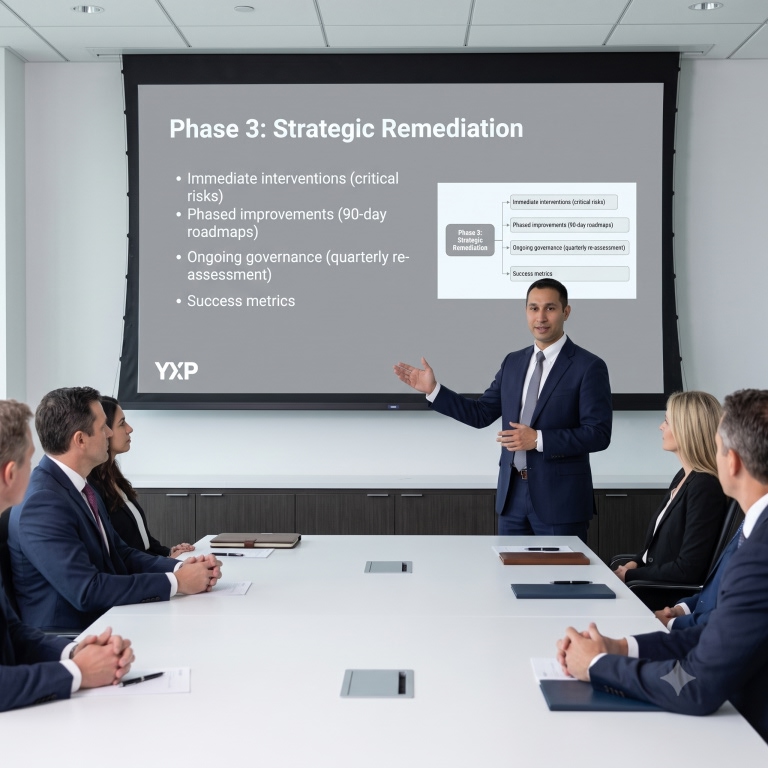
Phase 3: Remediation Roadmap
We provide clear, prioritized action plans:
- Immediate interventions (critical risks requiring urgent attention)
- Phased improvements (90-day roadmaps for systemic issues)
- Ongoing governance (quarterly re-assessment and Board preparation, via the Portfolio Governance Retainer)
- Success metrics (defined for post-engagement tracking)
Deliverable: Executable roadmap with resource requirements and timelines
The Result: You gain independent verification of product design organization health, early warning on threats to the exit multiple, and actionable intelligence to inform capital allocation.
Three Ways to Work With Us
Select the engagement model that matches your portfolio oversight needs:
Ongoing Governance
For: PE firms managing multiple portfolio companies requiring continuous oversight
Structure: Annual retainer with quarterly assessment cycles
What You Get:
- Quarterly health assessments
- Monthly executive touchpoints
- Board-ready scorecards
- Early warning systems + emergency escalation (48-hr SLA)
Fee anchor: $120,000 per year.
Use Case: Standard risk management for stable portfolio companies preparing for eventual exit
Exit Preparation
For: PE firms with a portfolio company 12-24 months from a planned strategic sale
Structure: One-time comprehensive intensive (typically 12 weeks)
What You Get:
- Full operational audit
- Key person succession protocols
- Design-system debt remediation roadmap for your team's execution
- Exit readiness documentation
Fee anchor: ~$110,000.
Use Case: Mitigate valuation adjustment risk before acquirers conduct due diligence
Acquisition Intelligence
For: Due diligence teams evaluating acquisition targets
Structure: Time-boxed deal-flow diligence (up to 30 business days)
What You Get:
- Risk evaluation
- Flight risk analysis
- Post-acquisition integration cost estimate
- Proceed / Renegotiate / Walk recommendation
Fee anchor: $35,000 (scaled by target ARR).
Use Case: Complement financial DD with product design org intelligence to prevent surprises
Executive Risk Briefing
For: PE Operating Partners who want a compressed, independent read on a single portfolio company before committing to a full engagement.
Structure: Confidential ten-business-day assessment from access provisioning.
- Confidential stakeholder interviews
- Ticket-level review across a bounded activity window
- Confidential risk scorecard across five core design maturity vectors
- Top-three findings with prioritized next steps
- 30-minute debrief
Fee: $15,000 flat. Credit applied against any full engagement scoped within 30 days.
Schedule BriefingBoard-Ready Intelligence, Not Just Reports
Depending on engagement scope, you receive executive-level documentation designed for your Board and investment committee:
Operational Risk Scorecards
Visual heat maps showing product design velocity, design leadership dynamics, human capital stability, design-system debt, and product design team maturity—benchmarked against established maturity frameworks.
Key Person Risk Analysis
Dependency mapping identifying critical knowledge concentration and flight-risk exposure indicators, with recommended investigation priorities.
Capital Efficiency Metrics
Where ticket-level data supports it, quantification of wasted engineering capacity and velocity gaps translated into dollar impact.
Exit Readiness Assessment
Diligence-ready documentation demonstrating your portfolio company's product design org is prepared for buyer-side scrutiny.
Quarterly Governance Updates
Trend analysis showing improvement or degradation across risk vectors, allowing you to track remediation effectiveness and identify emerging issues.

Kyle Averack
Credentials:
- Former Lead Product Designer for GenAI: Amazon AWS (Enterprise AI Platform)
- U.S. Patent Holder: Sony PlayStation Architecture
- 15+ Years Enterprise Experience
Institutional Background:
- Coursera: Architected the AI-ready design system and agentic production pipeline for the brand and creative marketing organization — semantic token architecture, automation-candidacy scoring, and a live ChatGPT-to-Figma generation pipeline — producing $1.55M in projected 3-year savings.
- Amazon Q Developer (AWS): Architected the design and trust framework for Amazon AWS GenAI Assistant — reducing DevOps root-cause-analysis workflows by 70%.
- Paychex: Directed design operations for a 60+ person distributed org; led AI chat assistant integrations that eliminated $12.7M in annual costs via a 72% reduction in call center volume.
- Hilton: Drove a 3% conversion lift across a $2B revenue funnel through product design velocity optimization.
- Sony PlayStation Now: Consolidated 50+ fragmented operational tools into a unified cloud gaming infrastructure platform.
- Blizzard Entertainment: Architected the token-based, object-oriented design system for Blizzard's cross-studio platform — establishing governance frameworks that accelerated design-to-development velocity by 40%.
How the Framework Was Built

Origin Engagement · Design-System Debt
Coursera
The Business Problem: A distributed creative organization was paying full designer labor costs for output that automation could absorb — but no one had mapped where the automation boundary actually sat. Every asset required manual production from scratch, at headcount scale.
Operational Environment: Marketing organization at EdTech scale — distributed creative function requiring AI-augmented output without proportional headcount growth.
Analytical Approach: Audited the full design-to-production workflow for automation candidacy. Mapped fragmented token architecture across the existing design infrastructure. Evaluated AI generation pipeline viability and designed the semantic layer required to make it production-reliable.
$1.55M projected 3-year savings
Architected semantic token system + live ChatGPT-to-Figma agentic pipeline

Origin Engagement · AI Governance & Trust Framework
Amazon AWS — Amazon Q Developer
Operational Environment: Amazon AWS GenAI Assistant — an enterprise AI product used by DevOps teams to diagnose and resolve infrastructure failures on production systems.
The DesignOps Problem: No design trust framework governed the product's most critical user flow — the moment an engineer decides whether to act on an AI recommendation affecting live infrastructure. Design and engineering were shipping without a governance model for that decision surface.
Analytical Approach: Audited the complete DevOps root-cause-analysis workflow. Mapped trust-critical decision surfaces. Designed the information architecture and trust signal framework governing how the AI surfaced confidence, uncertainty, and recommended action.
70% reduction in DevOps root-cause-analysis time
Governance framework for AI-to-engineer trust signal architecture
Origin Engagement · Org-Scale Governance & Key Person Risk
Paychex
Operational Environment: Distributed design organization of 60+ practitioners across multiple product lines, responsible for HCM and payroll software serving hundreds of thousands of SMB clients.
The DesignOps Problem: A 60-person design org without centralized operational governance is a key-person-dependency factory. Knowledge concentration, inconsistent process, and absence of shared operational infrastructure meant velocity was org-chart-dependent rather than system-dependent.
Analytical Approach: Rebuilt the operational infrastructure of the design org for deeper AI integration — established UX metrics, integrated research directly into product development lifecycles, and decentralized design system resources to unlock cross-team velocity. The AI chat assistant integration succeeded at deflection scale because the org could execute it without the bottlenecks that had previously absorbed capacity.
$12.7M in annual operational cost eliminated
72% reduction in call center volume via AI chat assistant governance
Origin Engagement · Post-M&A Design-System Consolidation
Blizzard Entertainment
Operational Environment: Multi-studio game development organization with fragmented design tooling across titles and teams, each operating with its own conventions.
The DesignOps Problem: Cross-studio fragmentation is the design-system equivalent of technical debt after a roll-up acquisition. Each studio shipped independently — no shared token architecture, no governance framework, no mechanism to accelerate velocity across the organization.
Analytical Approach: Architected a token-based, object-oriented design system for cross-studio deployment. Established governance frameworks that could operate across autonomous creative teams without centralized approval bottlenecks.
40% acceleration in design-to-development velocity
Token-based design system deployed across autonomous cross-studio org
Frequently Asked Questions
How is DesignOps Due Diligence different from Technical Due Diligence?
Technical DD evaluates code quality and maintainability. Product DD evaluates roadmap and market fit. DesignOps DD evaluates whether the design organization can execute at the velocity, quality, and stability the exit narrative depends on. These three assessments are orthogonal, not competing. Tech DD tells you if the code is maintainable. Product DD tells you if the strategy is sound. We tell you if the team and system built to ship that strategy is stable.
Why can't we just ask our VP of Product for this assessment?
Because they're inside the system they'd be assessing. Proximity makes structural friction hard to see from the inside, no matter how good the VP is — and their reporting line runs to the same CEO who owns the roadmap being assessed. We report only to you, the capital allocator — the same reason boards use an external financial auditor instead of asking the CFO to audit their own books. It's a structural safeguard, not a comment on anyone's ability.
Why shouldn't I just hire a design agency?
Agencies are incentivized to prolong engagement and sell production hours. YouX Prime is an oversight function. We audit agencies and internal teams to verify they're delivering at the velocity and quality your investment thesis depends on. We don't design the assets; we verify the assets are built for capital efficiency and exit readiness.
How do I know your findings aren't shaped by who's paying you?
We take money from one party: the client who hired us. No vendor fees, no commissions, no revenue share from anyone we recommend. And we don't do the fixing. Every SOW we sign puts execution explicitly out of scope — we diagnose and recommend; your team or your agency executes. That's not a positioning statement, it's a written exclusion in the engagement. That's what makes the scorecard worth having: we have no reason to be wrong in either direction. When a portfolio company comes back clean, we'll tell you it's clean and go away.
Why not just run an AI design audit?
Because a model only knows what you put in front of it—and it won't tell you what you forgot to show it. Feed it a clean Jira export and it returns a clean-looking analysis, never flagging that velocity "looks fine" only because the team quietly stopped logging blocked tickets two quarters ago. The work isn't summarizing the data; it's knowing which data to distrust, and reading how product, engineering, and design actually hand off to each other—the procedural and political seams where value leaks, which don't appear in any single tool's export. Reading that gap is human judgment, not compute.
What makes your assessment methodology different?
We audit operational systems, not opinions. We access raw data—Jira velocity metrics, Figma usage patterns, design system analytics—and use those findings in combination with supported observable evidence. Our frameworks are informed by building operational systems at Amazon, Sony, and Paychex that processed billions in transactions. We apply institutional-grade rigor to mid-market assessments.
Do you guarantee valuation impacts?
No. We provide independent assessment and advisory services based on rigorous methodologies. Our role is to provide objective intelligence to inform your decisions. Final strategic and personnel decisions remain solely with you. While we apply financial modeling to demonstrate potential impact, these are illustrative estimates, not guarantees.
What access do you require to our portfolio companies?
Our Executive Risk Briefing requires read-only access to project management tools, design infrastructure, and a product staging environment, plus completion of a confidential 20-item practitioner survey by 1–2 lead designers. No interviews or synchronous meetings with portfolio company staff are required at this tier. Full protocol engagements extend to stakeholder interviews and broader access, as specified in the SOW.
How do engagement fees work?
Engagement structure and investment levels are determined during initial consultation based on portfolio composition, complexity factors, and oversight requirements. We provide transparent fixed-fee proposals with clear deliverables and timelines. Volume arrangements are available for PE firms deploying governance across multiple portfolio companies.
Can we start with a single portfolio company?
Absolutely. Most PE firms begin with a single engagement to establish methodology. Upon successful completion, expansion to additional portfolio companies typically occurs within 3-6 months. We also offer a compressed Executive Risk Briefing as an entry point.
Schedule Your Portfolio Assessment
For PE Operating Partners managing B2B SaaS, FinTech, or PropTech portfolios.
If any of the following apply, we should talk:
- You're 12-24 months from a planned exit
- Your portfolio company's product is a patchwork from M&A that a strategic buyer won't accept as-is
- The team ships fast, but what ships doesn't track the roadmap
- A key person departure has already disrupted velocity at one of your companies
- Your portfolio company keeps missing roadmap commitments
- You're evaluating an acquisition target and want product design organization intelligence
Initial Consultation Includes: Portfolio composition review, highest-risk asset identification, engagement model recommendation, sample deliverable review, and transparent fee structure discussion.